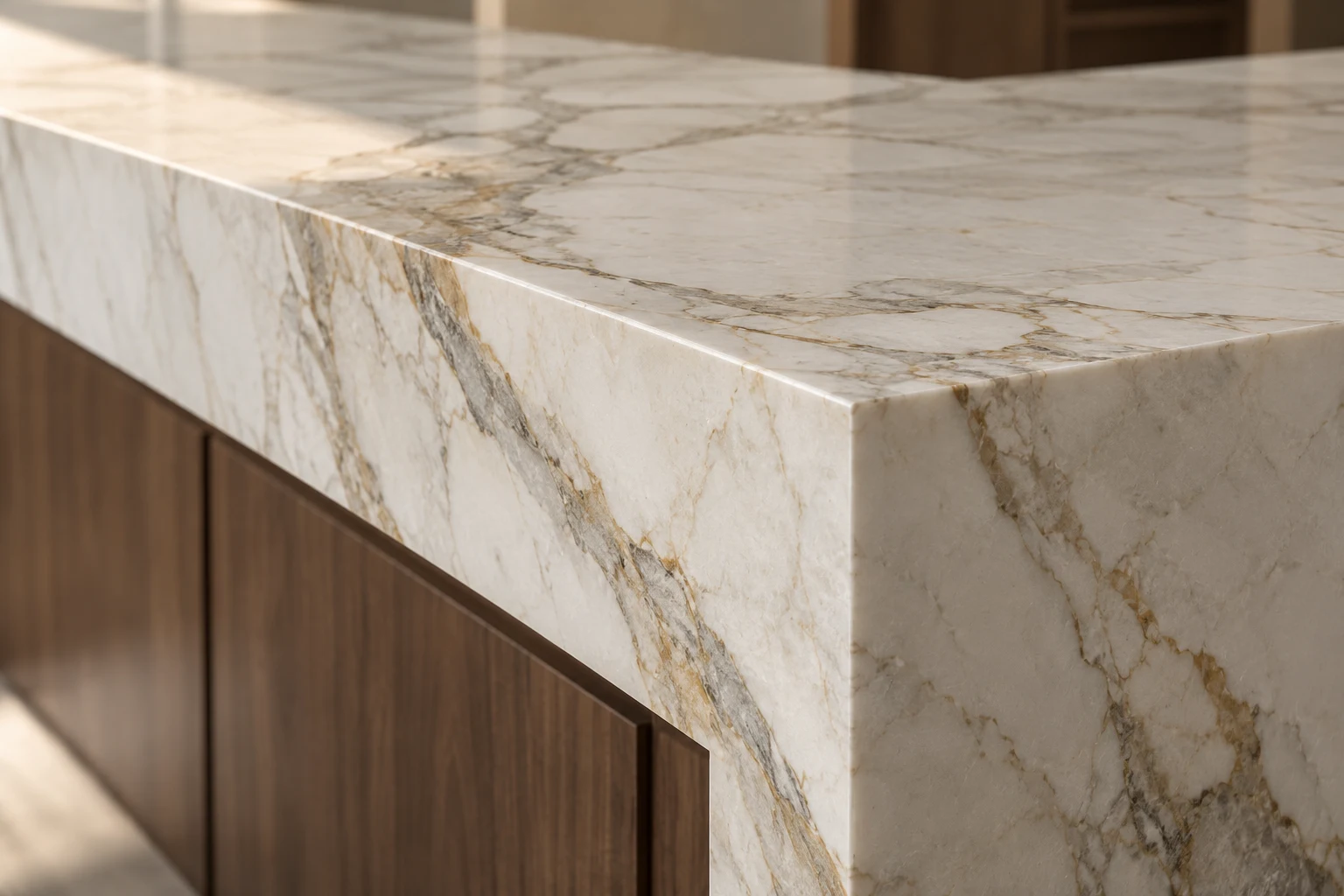
Eased: a quiet outline
An eased edge keeps a mostly straight face with the sharp arris lightly softened. Agree on the radius and finish with your fabricator; “eased” does not specify one universal radius.
Ogee: a shaped profile
An ogee has a concave-convex, S-like profile. Shaping and finishing those curves can require additional tooling and labour compared with a simple eased edge. The premium depends on the shop, material and complexity.
Miter build-up: visual depth
A mitered apron can create a 3-inch face without making the entire top 3 inches thick. Planning, bevel cutting, bonding, alignment and finishing the assembly add operations. The diagram is schematic; the project needs its own fabrication details.
Compare scope, not assumptions
Ask which edges are included and which are upgrades. Confirm the quoted linear footage, inside and outside corners, exposed ends and waterfall returns. There is no universal price increase that applies to every stone or shop.
Read an edge in the room
A thin-looking line can make cabinetry feel lighter; a deep apron gives an island a stronger presence. Neither effect tells you how much stone is actually inside. Review the edge from standing and seated positions, especially where knees, stools and cabinet doors share the same space.
Ask for a finished sample
Bring a drawing and ask to see a representative finished edge. Look at the transition through corners, the polish on the face and the appearance of bonded joints. Define the intended result before comparing prices: the name of a profile alone does not describe every finishing decision.
CONTINUE THE CONVERSATION
What are you imagining?
Tell us which object or material interests you. The collection is in development; we are not accepting orders or payments.
Contact The Haus ↗